Supporting spiritual care through service delivery
UX research / Service design / Co-design
About
Timeline: 1 year
Role: Design researcher
Goal
Understand spiritual care services in Ontario long-term care homes and identify gaps and opportunities.
Outcome
Collaborated with long-term care staff and conducted qualitative and quantitative research to understand spiritual care services. Explored opportunities for service intervention.
Problem:
Spiritual care in long-term care homes is misunderstood
While spiritual care is a required service within long-term care homes, it remains greatly underdocumented and difficult to define within healthcare contexts.
As long-term care residents and staff navigate aging, loss, and end-of-life experiences, spiritual care plays an important role in supporting well-being and a holistic approach to health. Despite its importance, it remains a largely misunderstood field within the context of long-term care.
For my thesis research, I applied a service design lens to better understand how spiritual care is delivered across Ontario long-term care homes and identify opportunities to strengthen support for both residents and care providers.
How is spiritual care currently provided in Ontario long-term care homes, and what opportunities exist to better support those delivering it?
Process:
Mixed-methods research study
I used a combination of quantitative and qualitative research to understand this complex service ecosystem.
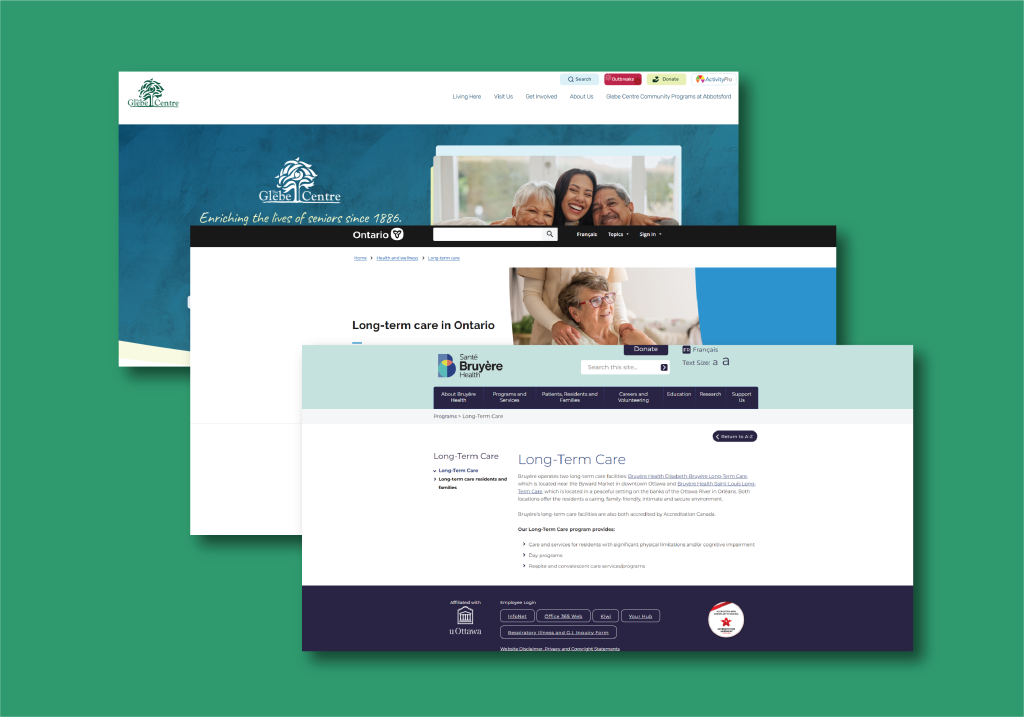
Environmental scan: Reviewing long-term care home websites
Reviewed and analyzed 210 Ontario long-term care home websites to review and document advertised spiritual care services. This offered a high-level understanding of spiritual care services across all homes in Ontario.

Survey:
Engaging long-term care administrators and spiritual care providers
Created a questionnaire sent to long-term care administrators to understand how spiritual care services were provided within their home. Received 55 responses.
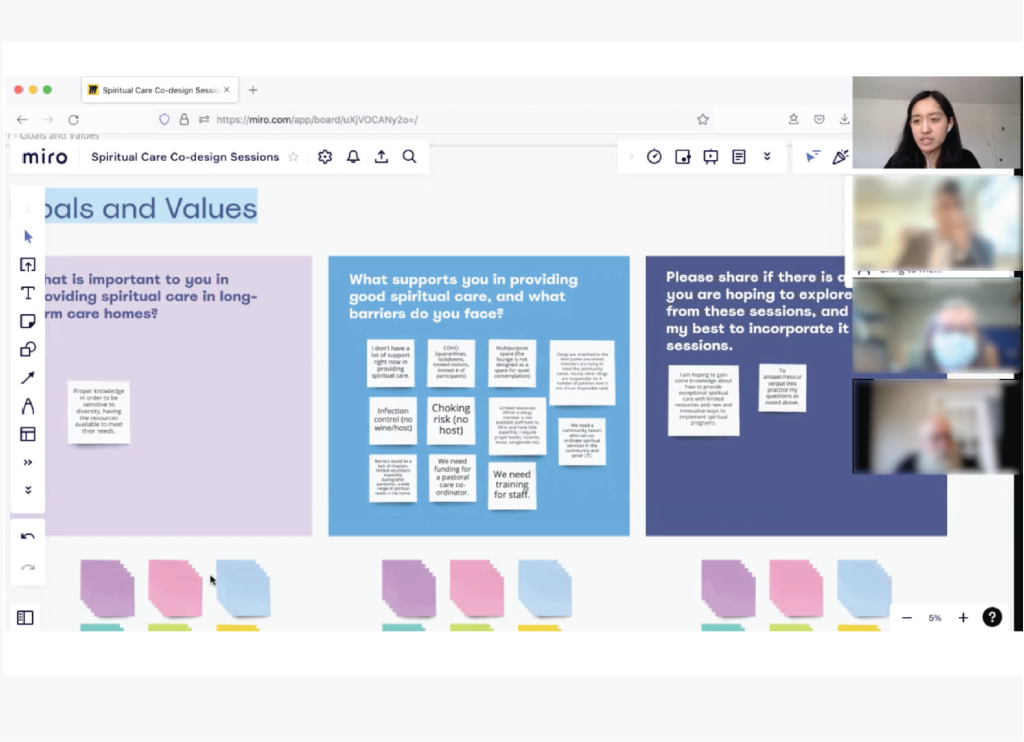
Co-design sessions: Understanding staff and care provider experiences
Led multiple co-design sessions with 10 long-term care staff (long-term care administrators, recreational care providers, and spiritual care providers). Open-ended discussions and activities to better understand each of their experiences and allowed for engagement and discussion between participants.
Insights:
Spiritual care as a unique form of care
The depth and breadth of data collected offered a unique perspective on spiritual care services in Ontario long-term care homes.
Insight 1
Spiritual care is diverse and evolving
“There’s so much we can do to connect with people spiritually, rather than religiously” (Spiritual care provider)
Participants described spiritual care as increasingly inclusive and holistic, extending beyond traditional religious practices to encompass meaning-making, connection, identity, and emotional support.
As resident populations become more diverse, providers are adapting services to support a broader range of spiritual needs and beliefs.
Insight 2
Spiritual care extends beyond formal structures and roles
“Spiritual care is a bit ‘fuzzy-boundaried” (Spiritual care provider)
Spiritual care is informal and ambiguous in nature, making it difficult to grasp in a medical environment.
While dedicated spiritual care staff often led programming, spiritual care was also delivered by recreation staff, family members, social workers, personal support workers, volunteers, and community leaders.
This revealed that spiritual care is less a single role and more a distributed network of support embedded throughout the home.
Insight 3
Relationships are the service
“You have to build rapport” (Spiritual care provider)
Across interviews, participants consistently emphasized the importance of human connection and relationship-building as a core part of spiritual care.
Informal conversations, trust-building, and presence were often viewed as equally important as formal programming, making spiritual care difficult to define through conventional healthcare structures.
Insight 4
Spiritual care is place-based
“Our physical building is bursting at the seams” (Long-term care home administrator)
Dedicated spaces for reflection, worship, and gathering were identified as important enablers of spiritual care.
However, many participants described these spaces as limited, under-resourced, or difficult to access, particularly during the COVID-19 pandemic.
Challenges
In the research data and conversations with participants, 3 systemic issues emerged in providing spiritual care.
- Lack of knowledge and training: Due to staff shortages, ,my recreational care workers are often taking on the leadership role in providing spiritual care, even though they do not feel they are sufficiently trained in providing spiritual care.
- Lack of staffing: Having a spiritual care provider on staff is often a luxury for a long-term care home. While many long-term care homes rely on volunteers and local community leaders to visit and provide spiritual care, survey results revealed that many of these leaders are retiring, leading to concerns about long-term sustainability of these services.
- Lack of space: Space is a incredibly valuable yet under-resourced asset that supports the delivery of quality spiritual care, especially during the COVID-19 pandemic.
Design opportunity:
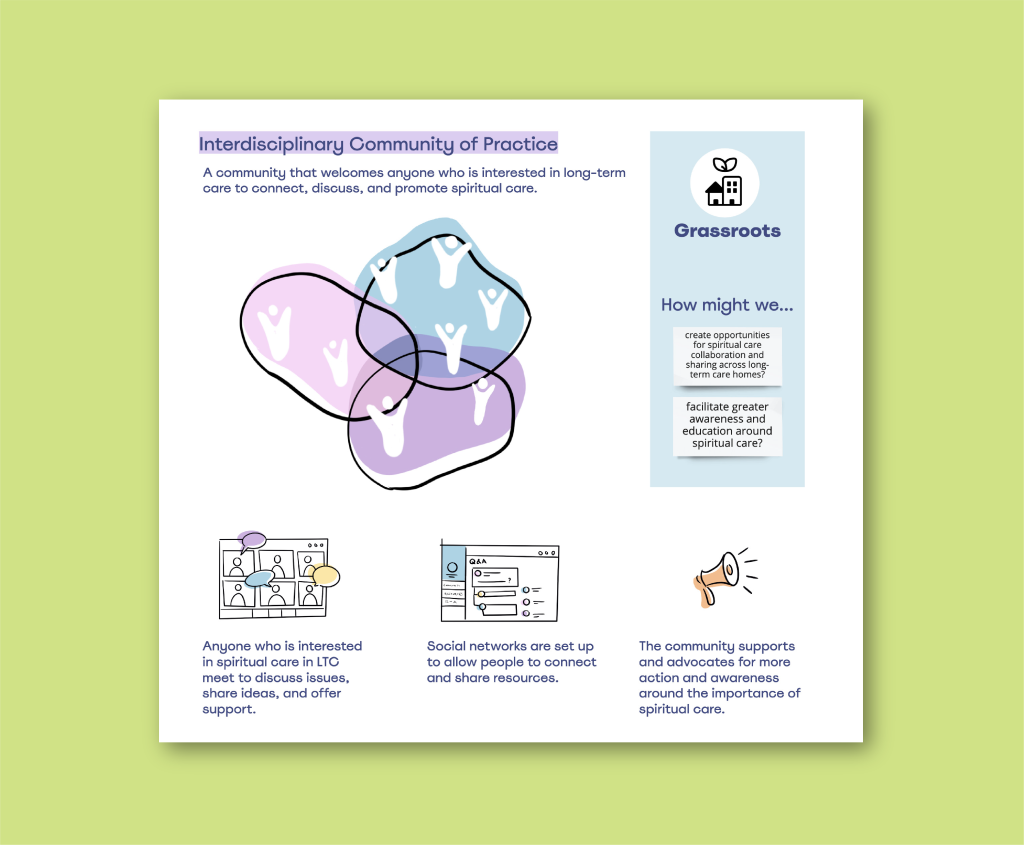
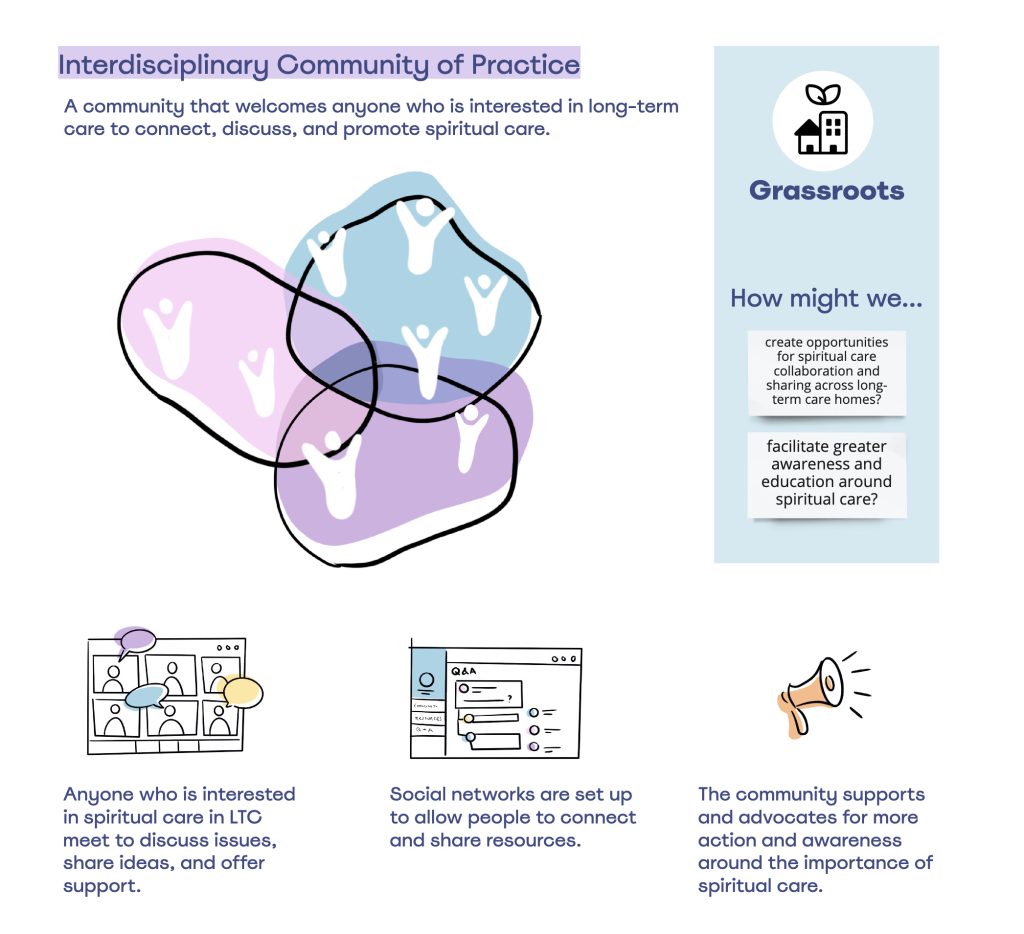
Community for care providers
Through co-design workshops, participants repeatedly expressed a desire to connect with others doing similar work.
Despite facing many of the same challenges, spiritual care providers often worked in isolation, with limited opportunities to share knowledge, resources, and experiences. This led to the identification of a key opportunity: developing a community of practice that could support peer learning, mentorship, resource sharing, and professional connection across long-term care homes. Rather than introducing a new service for residents, this opportunity focused on strengthening the support network behind spiritual care delivery itself.
Reflection
- Context is key: A thorough research methodology was crucial to understand the complexity of the long-term care and spiritual care service contexts, reveal the challenges experienced within the system, and identify opportunities for service design to improve and support caregivers.
- The user knows best: It was a privilege to speak with care providers who shared their stories during co-design sessions. Their passion for their work really helped me understand their struggles and highlighted their expertise as care providers and core contributors to the final outcomes of this research.
Next steps
- Sharing research at Long-term care presentations: This research was presented at This is Long-Term Care, a Canadian long-term care conference.
- Future research: To get a more wholesome understanding of the context, future research should focus on understanding the resident experiences of spiritual care.
View next project